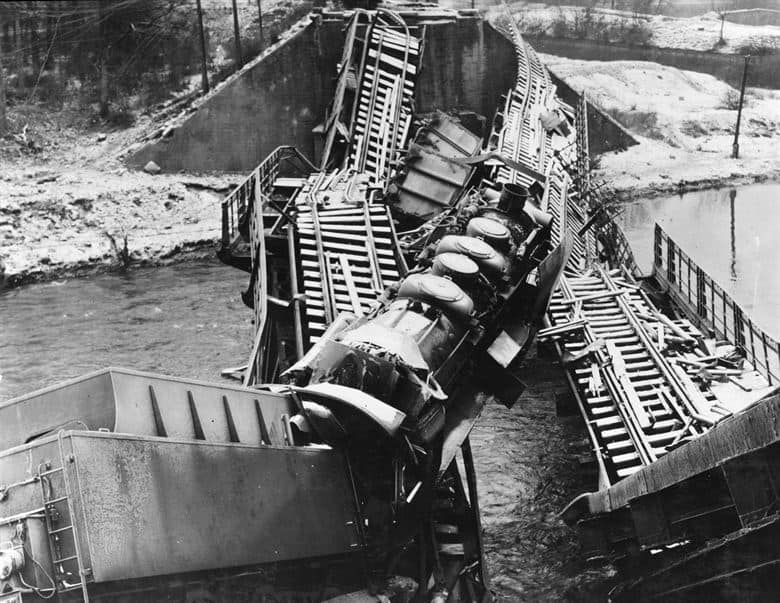
9th Air Force fighter-bombers caught this train trying to cross the Moselle River and destroyed both it and the bridge it was on. (U.S. Air Force photo)
For more detail, click on this link.
By Phil Kohn. Dedicated to the memory of his father, GM3 Walter Kohn, U.S. Navy Armed Guard, USNR, and all men and women who have answered the country’s call in time of need. Phil can be contacted at ww2remembered@yahoo.com.
On December 15, 1944, German troops attempt a breakthrough in the Ardennes region of Belgium and Luxembourg across an 84-mile front from Malmedy, Belgium, to Echternach, Luxembourg. The protruding salient, or bulge, in the front causes the fighting to be called the Battle of the Bulge. The Germans’ goal is the recapture of Antwerp, Belgium, now functioning as a major supply port for the Allies. In Asia, Chinese forces capture Bhamo, in northern Burma, about 116 miles south of Myitkyina and 40 miles from the Chinese border. Over the English Channel, a small, single-engine airplane flying from England to France disappears. The aircraft is carrying Maj. Glenn Miller, leader of the U.S. Army Air Forces Band (and leader of his own very popular orchestra prior to his joining the service). No trace of the aircrew, passengers or plane is ever found. Miller’s disappearance is not made public until Christmas Eve, the day before he is scheduled to conduct the band for a special BBC holiday broadcast.
American and Filipino troops land at Mindoro, the Philippines, about 75 miles from Manila, on December 16. The Allies make headway against relatively light Japanese resistance. In the air, however, the Japanese respond aggressively, sending planes, including waves of kamikazes, against Allied shipping. In Italy, Benito Mussolini gives a speech in Milan, maintaining that new German weapons will turn the tide of the war. A V-2 rocket hits a movie theater in Antwerp, Belgium, killing 567 people.
In Belgium, the Malmedy massacre takes place on December 17. German SS troops in the Belgian town suddenly begin machine-gunning a group of about 130 unarmed American prisoners of war taken during the German Ardennes offensive. Some of the POWs try to survive by playing dead, but the Germans walk among the bodies and shoot any that appear alive. When the Nazis move on, 84 POWs are dead. Eventually, 43 survivors make their way to U.S. lines to report the atrocity. In the Pacific, Typhoon Cobra hits Adm. William “Bull” Halsey’s Third Fleet east of Luzon in the Philippine Sea. Winds of over 120 miles per hour, extremely heavy seas and torrential rains cause three destroyers (USS Hull, USS Spence and USS Monaghan) to capsize and sink with the loss of 790 lives. Eleven other warships — a heavy cruiser, a light cruiser, two escort carriers, five destroyers and two destroyer escorts — are damaged so severely that they must be sent for major repairs. On the fleet’s aircraft carriers, 146 planes are damaged or washed overboard. A Court of Inquiry held shortly afterward and attended by Adm. Chester Nimitz, Commander-in-Chief, Pacific, despite finding that Halsey made “an error in judgement” in ordering the Third Fleet to sail into the heart of the typhoon instead of seeking shelter, chooses not to sanction Halsey. The experience inspires a naval officer who was aboard a ship caught in the typhoon, Herman Wouk, to use the storm as a crucial story element in his 1951 Pulitzer-Prize-winning novel, “The Caine Mutiny.”
Bastogne, an important roadway hub in Belgium’s Ardennes region, is surrounded by the Germans on December 18, trapping American troops positioned there. In Asia, the Japanese begin to retreat from Burma. In Washington, D.C., the Supreme Court of the United States hands down two decisions affecting the internment of Japanese-American citizens: it declares by a vote of 6-3 that the internment process was constitutional, but also decides unanimously that loyal citizens of the U.S., regardless of descent, cannot be detained without cause. The U.S. Western Defense Command announces that persons of Japanese descent found to be “either loyal or harmless” will be allowed to return to the coastal areas of California, Oregon and Washington, effective January 2, 1945.
On December 19, 84 U.S. Army Air Forces B-29s bomb Hankow, China, which remains ablaze three days later. In the East China Sea, the submarine USS Redfish torpedoes and sinks the brand-new Japanese aircraft carrier Unryū on her maiden voyage. Transporting kamikaze planes for use in the Philippines, Unryū goes down in under 10 minutes, taking 1,258 men with her. In Moscow, a state commission reports that over 300,000 civilians and 165,000 prisoners of war were killed by the Germans in Lithuania. The Germans capture 9.000 surrounded American troops in the Schnee Eifel region of the Belgian-German border, pushing the Allies back off German soil.
In Greece, British Lt. Gen. Ronald Scobie on December 20 warns Greek civilians to stay out of areas occupied by ELAS anti-loyalist forces or they may be subjected to bombing air raids. The Germans surround two vital Belgian road junctions: at St. Vith, south of Malmedy, and at Bastogne, near the Luxembourg border.
In the Philippines, elements of the U.S. XXIV Corps and the U.S. X Corps link up in the Ormoc Valley on Luzon on December 21. RAF bombers attack Bonn and Cologne, Germany. U.S. B-29 bombers attack Japanese-held Mukden, Manchuria. In Greece, the British use tanks and airplanes against communists north of Athens.
In Belgium, the battle for Bastogne is at its height on December 22, 1944, with the Americans running low on ammunition. The Germans send a mission under a white flag to the American force surrounded there, seeking a surrender. U.S. Army Brig. Gen. Anthony McAuliffe, acting commander of the 101st Airborne Division and its attached troops at Bastogne, sends his famous one-word reply: “NUTS!” (When the German major who receives McAuliffe’s reply, on his way back to the front lines, finally looks at what McAuliffe has written, he asks his American escort, Col. Joseph Harper, in befuddlement: “Nuts???” Harper tells him, “It means ‘Go to hell!’”)
In Belgium on December 23, in the Ardennes, the skies — typically heavily overcast at this time of year — clear, allowing Allied aircraft that had been grounded due to the weather to attack the Germans. This is a development that Hitler feared in his planning of the offensive. The U.S. First Army withdraws from St. Vith after holding a German assault off for a few days, while III Corps of the U.S. Third Army moves up to relieve the besieged troops at Bastogne. The Soviet breakthrough southwest of Budapest, Hungary, is now a battle-front 60 miles wide. In Antwerp, Belgium, 26 German V-2 rockets explode.
On December 24, in Belgium’s Ardennes, an American counterattack at “The Bulge” begins and the German offensive grinds to a halt. In the English Channel five miles off Cherbourg, France, the overloaded Belgian troop transport SS Léopoldville — carrying 2,233 U.S. Army reinforcements from England to France for the Battle of the Bulge — is torpedoed by German sub U-486 and slowly sinks, going under almost 2-1/2 hours later. Most of the soldiers do not realize the vessel is sinking, and do not understand the order to abandon ship, which is given in Flemish (Belgian Dutch). Three of the ship’s escort vessels — two British and one French — have sped off to hunt down the submarine. The one British destroyer left behind begins to take soldiers off Léopoldville, but it reaches its maximum capacity of 500 rescuees and heads for shore. Unfortunately, shore-based communications and command posts are minimally staffed because of holiday celebrations. It takes over an hour for anyone in authority ashore to learn about the troopship that is sinking with over 1,200 troops still aboard and to begin coordinating rescue efforts. Ultimately, more than 800 lives are lost, 763 of them members of the 66th Infantry Division. All news and information on the incident are suppressed by orders of SHAEF (Supreme Headquarters, Allied Expeditionary Force). Soldiers of the 66th Division are ordered not to tell anyone of the sinking, and their letters home are censored by the Army. Upon discharge, they are reminded not to mention the sinking of Léopoldville to the press, or their GI benefits as civilians will be rescinded. Documentation about the incident remains classified until 1996. In the U.S., all beef products are once again being rationed, and new quotas are introduced for most other products as well.
The last Japanese port on Leyte, Palompon, is captured on December 25; Gen. Douglas MacArthur declares that Leyte is secured, except for “the mopping up.” In Europe, intense fighting between Soviet troops and German and Hungarian forces occurs northwest of Budapest. The Red Army is now less than 100 miles from Vienna, Austria.
The siege at Bastogne is broken with the arrival of U.S. troops from the south on December 26. With that turn of events, the German Ardennes offensive proves a failure. The Allies claim to have captured 13,273 German prisoners, while the Germans claim to have taken over 30,000 Allied POWs and to have destroyed 700 Allied tanks.
The Red Army on December 27 captures Esztergom, Hungary, about 29 miles northwest of Budapest on the right bank of the Danube River at the Hungarian-Slovakian border. With the encirclement of Budapest now complete, the Soviets cut off all communications with the Hungarian capital and trap five German and Hungarian divisions.
Over Germany on December 28, 1,200 Allied B-17 Flying Fortress heavy bombers, accompanied by over 700 escort fighters, bomb Coblenz and Cologne. British Prime Minister Winston Churchill and British Foreign Secretary Anthony Eden are in Athens trying to reconcile the warring factions there. In Hungary, an anti-German Provisional National Assembly, encouraged by the Soviet Union and headed by Béla Miklós, is established in opposition to the pro-German government of Ferenc Szálasi. Both Szálasi and Miklós claim to be the legitimate head of government; their supporters battle throughout the country. The Miklós government renounces all treaties with Germany. In Belgium, the Americans gain ground in their counteroffensive in the Battle of the Bulge. Hitler, ignoring the advice of his generals, orders further offensives in Alsace and in the Ardennes.