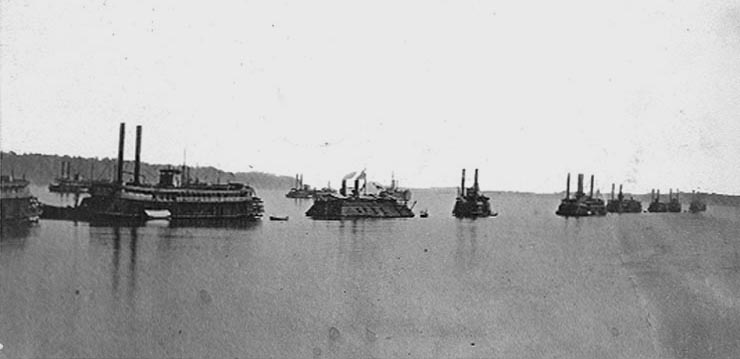
Mississippi Squadron Gunboats off the Naval Station at Mound City, Illinois, circa 1863. Ships include USS Key West (1863-64) at left, with her number (32) painted on her pilothouse; at least ten other “Tinclad” gunboats; one “City” class ironclad (just astern of Key West; and one “Timberclad” gunboat (seen beyond the ironclad’s stern). /U.S. Naval Historical Center
August 1865
By Phil Kohn
Phil Kohn can be reached at USCW160@yahoo.com
As of August 1, 1865, in Nashville, Tennessee, the military tribunal hearing the case of former Confederate partisan ranger and guerrilla Samuel “Champ” Ferguson continues (it began on July 11). Testifying against Ferguson is former Unionist guerrilla leader David “Tinker Dave” Beatty, Ferguson’s primary adversary during the war. And just as Ferguson and his men attacked real or presumed Unionists in the area, Beatty’s group was said to prey on real or presumed Confederate sympathizers with equal viciousness. Both groups often tried to ambush and kill each other. During his own testimony, Ferguson admits to the deaths of many of the 53 people named in the charges against him, and states that, in fact, he had killed over 100 men himself. He argues, however, that the activities for which he is being charged are simply part of the duty of being a soldier.
The U.S. Army is very busy, discontinuing departments, districts, Armies and Corps that are no longer needed. Among these are: the Armies of the Cumberland, the James, the Tennessee and Arkansas, and the following Corps: VII, VIII, X, XIV, XXII and XXIV.
Prowling the Pacific Ocean far off the Mexican coast in a so-far unsuccessful hunt for U.S.-flagged ships to capture, Lt. James Waddell, captain of the raider CSS Shenandoah, decides to attack shipping at San Francisco, conjecturing that San Francisco Bay — so distant from the war — will be lightly defended. On August 2, Shenandoah encounters the British bark Barracouta heading for Liverpool, England, 13 days out of San Francisco. The English captain informs Waddell that the Confederate government has collapsed, and the war is over. Waddell immediately orders his ship and his crew to be disarmed, with weapons stowed below decks. Unwilling to return to the United States (where he fears that he and his men could possibly be charged with piracy), Waddell has the ship re-painted to resemble a merchantman and sets sail southward toward Cape Horn, at the tip of South America, with the goal of reaching Great Britain and surrendering there.
Comm. Henry Bell, USN, replaces Capt. Cicero Price as commander of the East India Squadron, at Hong Kong, China, on August 11. On station since 1835, the squadron is charged with protecting American citizens and shipping and suppressing piracy in East Asian waters. During the Civil War, an additional responsibility was protecting shipping from Confederate raiders off the coast of Asia and in the western Pacific Ocean.
The U.S. Navy on August 12 reactivates its Brazil Squadron, headquartered at Rio de Janeiro, Brazil. In command is Rear Adm. Sylvanus Godon, flying his flag in the sidewheel steam frigate USS Susquehanna. The squadron’s mission is to protect U.S. citizens and shipping in the South Atlantic Ocean and to ensure that no U.S.-flagged ships are engaged in the slave trade. (Brazil did not abolish slavery until May 1888, the last country in the Western Hemisphere to do so.)
The U.S. Navy discontinues it Mississippi River Squadron on August 14.
On August 15, a band of about 1,000 former Confederates led by Brig. Gen. Joseph O. “Jo” Shelby, reaches Mexico City, Mexico. Having refused to surrender, they left Texas with cannon, small arms and ammunition, crossed the Rio Grande, where they sank their Confederate flags in the river, and headed south. They offer their services to the French-installed Emperor Maximilian, but he demurs, giving them only the option of becoming immigrant settlers. Many, including Shelby, accept the invitation, while others join the Mexican Army or move on, some ultimately sailing to South America and establishing colonies there. In Kansas, at the mouth of the Little Arkansas River where it joins the Arkansas River northwest of Wichita, representatives of the United States and the Apache, Arapaho, Comanche and Kiowa tribes sign a treaty of peace.
On August 23 a military tribunal convenes in Washington, D.C., to hear the case of former Confederate Capt. Henry Wirz, who had been the commandant of the Camp Sumter prisoner-of-war facility near Andersonville, Georgia. Captured in May, Wirz is being tried for multiple war crimes related to his conduct of Camp Sumter and for personal violations of the rules of warfare. The tribunal is very high-profile and gets much newspaper coverage. The presiding officer is Maj. Gen. Lew Wallace. Other members include Brig. Gens. Gershom Mott, John Geary, Lorenzo Thomas, Francis Fessenden and Edward Bragg. The prosecutor is Col. Norton Chipman of the U.S. Army Judge Advocate General’s Corps. The charges against Wirz are: “. . . combining, confederating and conspiring with [a number of named and unnamed Confederate officials] to injure the health and destroy the lives of soldiers in the military service of the United States” and for 13 murders “in violation of the laws and customs of war.”
Sixty-six Union generals are mustered out of the U.S. Volunteers on August 24. Among the more prominent are major generals Nathaniel Banks, Daniel Butterfield, Abner Doubleday and Samuel Heintzelman. Of these four, only Banks leaves the army; the others continue their military careers in the regular army: Butterfield, colonel of the Fifth Infantry; Heintzelman, colonel of the 17th Infantry; and Doubleday, lieutenant colonel of the 17th Infantry.
President Andrew Johnson on August 29 issues Proclamation 145 stating that as of September 1, 1865, even articles declared as “contraband of war” may be traded within states “recently declared in insurrection.” In this case, “contraband of war” is defined as materials that could be used for military purposes and not escaped slaves.
Maj. Gen. Henry Halleck — formerly general-in-chief of the Union Army and then Army chief-of-staff under Lt. Gen. Ulysses Grant — arrives in San Francisco, California, on August 30, to take command of the Division of the Pacific, a major command that oversees the states of California and Nevada and the territories of Arizona, Idaho, Oregon and Washington.
On August 31, Washington College, in Lexington, Virginia, a small, private, liberal-arts school, names Robert E. Lee, former general-in-chief of the Confederate Army, as its new president. Lee, in financial difficulties following the war’s end, has spurned a number of employment offers from business firms, feeling that they were proffered more to take advantage of his name than to utilize his capabilities. Lee says he will take the college job because he wants to “train young men to do their duty.”