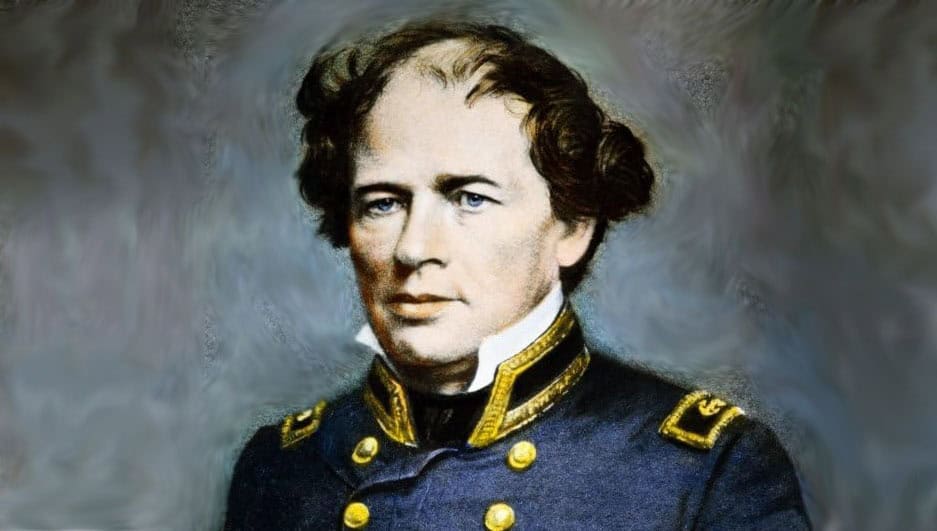
Matthew Fontaine Maury
September 1865
By Phil Kohn
Phil Kohn can be reached at USCW160@yahoo.com
As of September 1, 1865, the military tribunal hearing the case of Henry Wirz, former commandant of Camp Sumter, the military prison near Andersonville, Georgia, continues (it began on August 23). One witness is a 62-year-old Irish Catholic priest who had come to be known among the prisoners as “The Angel of Andersonville” for the kindness and care he showed them. The Rev. Peter Whelan spent almost four months at the camp — from mid-June to late September 1864 — ministering to the prisoners. He testifies under oath that although Wirz used profanity and sometimes spoke harshly to the prisoners, he had not seen the commandant personally inflict any harm that caused death, nor had he heard any stories or rumors of such acts. The priest notes it was highly likely that he would have heard of any such violence had it occurred during the time he was at the prison, as he was there daily. The trial continues throughout the month and beyond, hearing from more than 160 witnesses, including former prisoners and guards at the camp, and former Confederate officers, including Robert E. Lee.
Union Brig. Gen. Alexander Schimmelfennig dies on September 7 at a sanatorium in Wernersville, Pennsylvania, while being treated for tuberculosis that he contracted while serving in South Carolina. Having held several commands at Charleston, South Carolina since July 1863, Schimmelfennig at the end of the war headed the 1st Separate Battalion, Department of the South, based at Charleston. The Prussian-born officer, unfortunately, is most widely known for his two days hiding from the Confederate Army in a pig sty in Gettysburg, Pennsylvania, during that battle in July 1863.
On September 11, Emperor Maximilian of Mexico approves a document, “Regulations and Instructions,” prepared by former Confederate Navy Cdr. Matthew Fontaine Maury to encourage disaffected Southerners and Confederate sympathizers to emigrate to Mexico. Considered the founder of the science of oceanography, Maury is serving in Maximilian’s cabinet as Imperial Commissioner of Colonization. Maury had been in the West Indies when the Confederacy collapsed, so he headed to Mexico and offered his services to Maximilian, whom he had previously met on his travels through Europe for the Confederate government.
In accordance with President Johnson’s policy of reconstruction, Alabama on September 12 initiates a constitutional convention.
At Fort Smith, Arkansas, on September 13, representatives of nine Indian tribes that had been treaty allies of the Confederate government — Cherokees, Chickasaws, Choctaws, Creeks, Osages, Quapaws, Seminoles, Senecas and Shawnees — meet with commissioners appointed by President Andrew Johnson. On the East Coast, South Carolina holds a constitutional convention per the reconstruction policies of President Johnson.
Representatives of the nine Indian tribes meeting with U.S. commissioners at Fort Smith, Arkansas, on September 14 sign a formal agreement renouncing all covenants that had been signed with the Confederacy and acknowledge that the U.S. government has jurisdiction over them.
The former Confederate raider CSS Shenandoah on September 16, sailing towards Great Britain and attempting to avoid U.S. Navy vessels, rounds Cape Horn on the southern tip of South America.
On September 21, the U.S. government signs agreements with groups within the Choctaw, Chickasaw and Shawnee tribes that had remained loyal to the U.S. in the Indian Territory during the war. The pacts call for peace and friendship and the abolishment of slavery by the tribes.
After some 56 days, on September 26, the military tribunal in Nashville, Tennessee, that is trying the former partisan ranger/guerrilla Samuel “Champ” Ferguson for war crimes — 53 murders in violation of the rules of war — finishes hearing testimony. As reported in the Nashville newspapers, “witness after witness” has testified. Of these, Ferguson is able to successfully call very few in his favor. He does, however, manage to obtain from the respected former Confederate cavalry general Joseph Wheeler testimony and evidence (in the form of muster rolls and payroll sheets) that Ferguson had, indeed, been mustered into Confederate service and commissioned a captain for part of the war. Ferguson and his men had served for a brief period under Wheeler’s command. Wheeler notes, however, that he does not know Ferguson personally and is not intimately knowledgeable of his activities. (Interestingly, Joseph Wheeler goes on to volunteer for service in the U.S. Army for the Spanish-American War in 1898, at age 61. He is appointed major general of volunteers by President William McKinley and commands a cavalry division that includes Theodore Roosevelt’s Rough Riders. He is also second-in-command of the U.S. Fifth Army Corps. In 1899, Wheeler fights in the Philippines-American War, where he is mustered out of volunteer service and commissioned a brigadier general in the regular army, which he had left 39 years earlier to join the Confederate Army. Wheeler retires from the U.S. Army with the rank of brigadier general on 10 September 1900, his 64th birthday. He is buried in Arlington National Cemetery.)