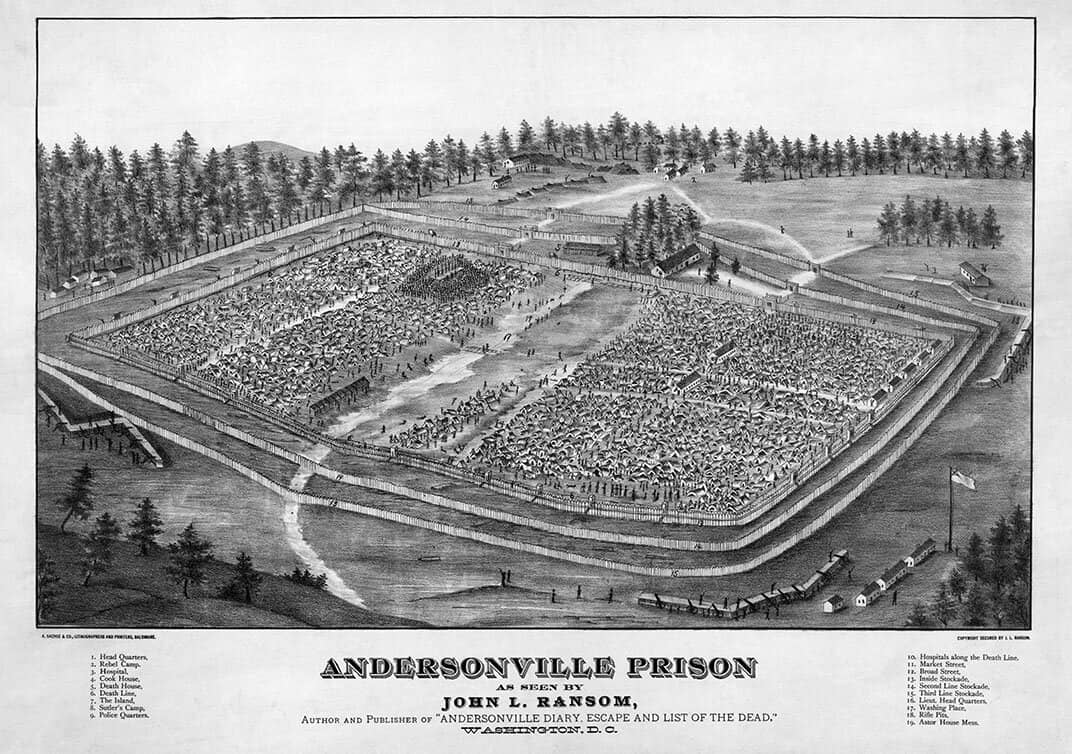
Andersonville Prison, as seen by John L. Ransom, a former Union prisoner /U.S. Library of Congress
October 1865
By Phil Kohn
Phil Kohn can be reached at USCW160@yahoo.com
As of October 1, 1865, the military tribunal in Washington, D.C., that is trying the case of Henry Wirz, former commandant of Camp Sumter, the Confederate prisoner-of-war camp near Andersonville, Georgia, continues hearing witnesses. The testimony of one witness is particularly damaging to Wirz. Stating his name as Felix de la Baume and claiming to be a descendant of American Revolutionary War hero the Marquis de Lafayette, de la Baume testifies that he was an eyewitness to the murder of an individual by Wirz and could name the victim. A skillful public speaker whose story is compelling, de la Baume becomes a “star” in the newspapers. In addition, de la Baume, following his testimony, receives a written commendation, signed by all members of the tribunal, for his part in the trial.
Georgia opens a constitutional convention on October 2. In Mississippi, former Confederate Brig. Gen. Benjamin Humphreys is elected provisional governor. He will remain governor of Mississippi throughout much of Reconstruction. North Carolina opens a constitutional convention.
At Nashville, Tennessee, on October 10, the military tribunal considering the case of former Confederate guerrilla Samuel “Champ” Ferguson reconvenes. The commission finds Ferguson guilty on 23 of the 53 murder charges against him and orders him executed by hanging. Ferguson thus becomes the second Confederate soldier convicted of war crimes and sentenced to death for actions committed during the war. (The first was Henry C. Magruder, tried in Kentucky in September and convicted of acting as a guerrilla and committing eight murders.)
On October 11, President Andrew Johnson orders the release on parole from confinement of five high-ranking Confederate officials. They are: Alexander H. Stephens, former Vice President of the Confederate States (and formerly and afterward a U.S. Representative from Georgia); John H. Reagan, former Confederate Postmaster General (and afterward a U.S. Representative and Senator from Texas); John A. Campbell, former Confederate Assistant Secretary of War (and formerly a U.S. Supreme Court Associate Justice); George A. Trenholm, former Confederate Secretary of the Treasury; and Charles Clark, former Confederate governor of Mississippi. At sea, the former Confederate raider CSS Shenandoah — having avoided any vessels of the U.S. Navy on its voyage through the Pacific and South Atlantic Oceans — on October 11 crosses the Equator and enters the North Atlantic Ocean. The goal of its captain, Lt. James Waddell, is to reach Great Britain and surrender to British authorities. His concern about returning to the United States is that he and his crew might be charged with piracy.
President Andrew Johnson on October 12 proclaims the end of martial law in Kentucky.
In Washington, D.C., on October 18, the Wirz tribunal adjourns. The members of the commission announce that they will study the evidence and testimony collected and will reconvene with their decision at a later date. In South Carolina, James L. Orr, a leader of the state’s “peace bloc” at the end of the war, is elected governor of South Carolina. A moderate, he will serve in office until 1868.
On October 20, at Nashville, Tennessee, Samuel “Champ” Ferguson is
executed, having been convicted of war crimes on October 10. His wife, Martha, and their 16-year-old daughter, Ann, witness the hanging. Afterwards, Martha and Ann receive Ferguson’s body and convey it for burial per his previous request, to White County, in east central Tennessee. On the same day, in Louisville, Kentucky, convicted war criminal Henry Magruder is executed by hanging.
Florida drafts a new state constitution on October 25 at Tallahassee, to re-establish the state as part of the United States. Martial law remains in force there, however. On the same day, the former Confederate raider CSS Shenandoah, sailing for England, is 500 miles southeast of the Azores. Off the coast of Georgia, a hurricane sinks the sidewheel steamer SS Republic, en route from New York to New Orleans with 77 passengers, 21 crew members and $400,000 worth of $10 and $20 coins for use as hard currency in the Southern city. (Because of the war, gold and silver coins are in very short supply in the Crescent City, a U.S. military transportation and commercial hub since its capture by Union forces in 1862.) The passengers and crew abandon ship, clambering into four lifeboats and a raft. All of the passengers and crew in the lifeboats survive and are rescued by a search vessel two days later. The raft is found two days later but only two of the original 18 people who were on it are saved. All the coins, however, are lost.