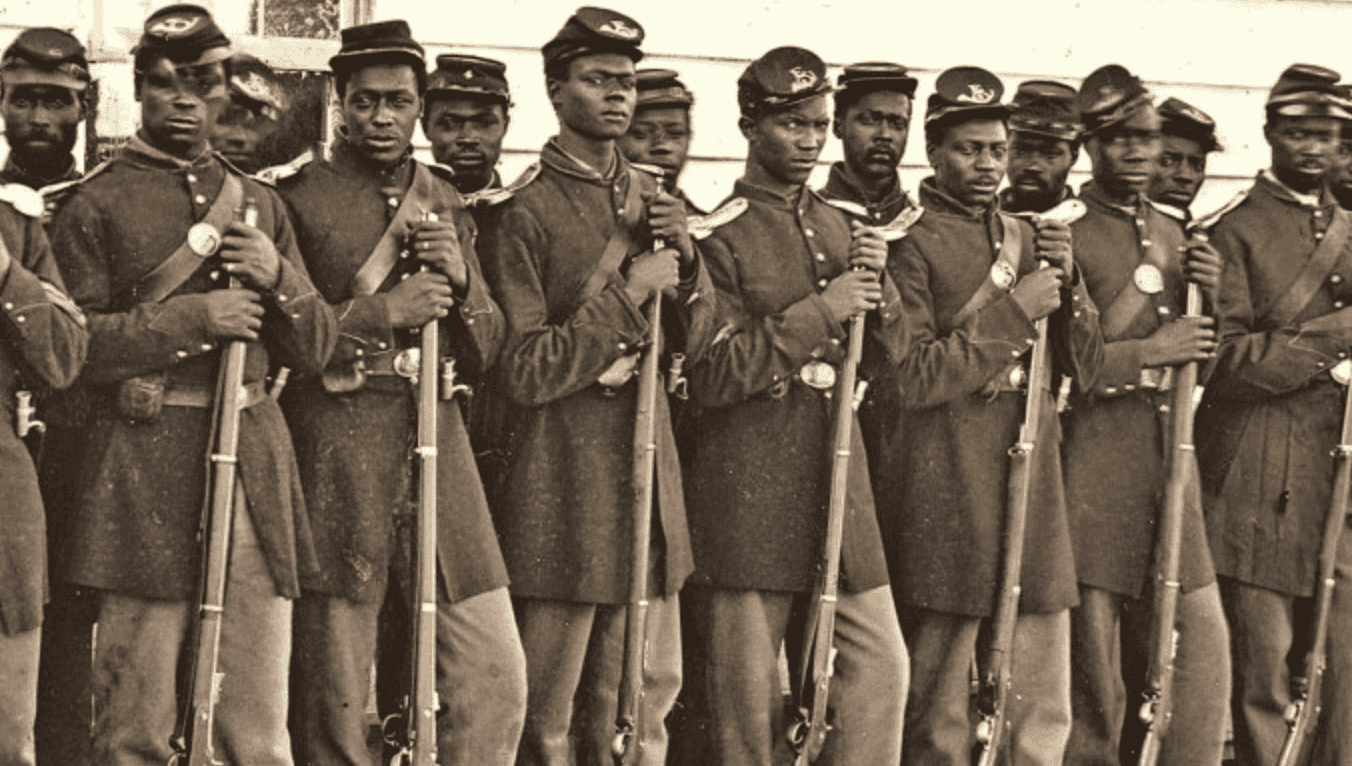
U.S. Colored Troops participate in a Grand Review in Harrisburg, Pennsylvania.
November 1865
By Phil Kohn
Phil Kohn can be reached at USCW160@yahoo.com
The U.S. Navy on November 1, 1865, discontinues its Atlantic and West Indies Squadrons, merging them into a newly created North Atlantic Squadron, headquartered at Hampton Roads, Virginia, and commanded by Comm. James Palmer. Often called “the Home Squadron,” its area of responsibility is the waters off Virginia and North Carolina, from the Potomac River to Cape Fear.
Secretary of the Navy Gideon Welles on November 3 orders all U.S. naval vessels to resume rendering honors when entering British ports and to again exchange official courtesies with British warships. These protocols were suspended during the war because of Great Britain’s support of the Confederacy and its granting of belligerent rights to Southern vessels.
On the evening of November 5, CSS Shenandoah arrives at the mouth of the Mersey River, off Liverpool, England — 94 days and 9,000 nautical miles (approximately 10,357 statute miles) since leaving the west coast of Mexico, where her captain, Lt. James Waddell, was told by the master of the British vessel Barracouta that the war had ended. Shenandoah lies at anchor waiting for a pilot to guide her upriver and to the docks. However, because the vessel is flying no flag, the pilot refuses to come aboard and take her into Liverpool.
In Washington, D.C., on November 6, the military tribunal charged with the trial of Henry Wirz, former commandant of Camp Sumter, the Confederate prison near Andersonville, Georgia, renders its decision. The commissioners declare that Wirz is guilty of conspiracy to “injure the health and destroy the lives of soldiers in the military service of the United States” and of 11 of the 13 counts of murder “in violation of the laws and customs of war” for which he was charged. Wirz is sentenced to death, becoming the second Confederate soldier convicted of war crimes. (Samuel “Champ” Ferguson, convicted and executed in Tennessee in October, was the first.) On the same day, CSS Shenandoah, now with her Confederate national flag and naval ensign flying, sails up the Mersey River at Liverpool, England, in thick fog, anchoring near the Royal Navy’s 101-gun, ship-of-the-line HMS Donegal. Shenandoah is boarded by a Royal Navy lieutenant from Donegal, accompanied by a detachment of armed sailors, who officially notifies Lieutenant Commanding James Waddell that the war is over, and that his government no longer exists. Waddell then surrenders his command to Capt. James Paynter, RN, in command of Donegal. At 10 a.m., Shenandoah’s Confederate flag and ensign are hauled down for the last time. Waddell then goes ashore and walks to the Liverpool Town Hall, where he presents the mayor with a letter surrendering the ship to the British government. The crew is ordered to remain aboard under guard of the Royal Navy until a decision can be made regarding their disposition. U.S. Minister to the United Kingdom Charles Adams, in London — notified of the situation by the U.S. consul at Liverpool — appeals to the British government that the ship be immediately turned over to the U.S. He also argues that since Shenandoah continued pillaging American vessels after being notified by them that the war was over, the Southern vessel was no longer a legitimate combatant, but a pirate ship, and her crew, pirates.
The 133 officers and crew of the former CSS Shenandoah on November 7 spend an uneasy day aboard the vessel awaiting their fate. With no duties to perform and forbidden from leaving the ship (they are guarded by armed British marines), time passes slowly.
On the morning of November 8, a specially convened, three-judge, legal panel in London notifies the British foreign minister, George Villiers, that Shenandoah and its entire equipage indeed should be turned over to the United States (which eventually happens). However, the panel rules that — based on testimony and statements made by Lt. Waddell (that he was following his orders and did not reliably know that the hostilities had ended), and with no evidence to the contrary — there is no basis for prosecution of the crew on charges of violations of the rules of war or of piracy, as argued by U.S. officials. At about 9 p.m., on orders from the British government, the Royal Navy — to the outrage of U.S. Minister Adams — unconditionally releases all 133 members of Shenandoah’s crew, including Lt. James Waddell, the commanding officer, allowing them to come ashore and disperse. Waddell finally returns to the U.S. in 1870, where he becomes captain of a commercial steamer. He dies at Annapolis, Maryland, in 1886, aged 61. In all, CSS Shenandoah in 13 months sailed 58,00 miles, in all oceans save the Antarctic, capturing 38 ships and over 1,000 prisoners (numbers second only to CSS Alabama). She is the only Confederate warship to circumnavigate the globe, and the very last Confederate military unit to surrender. In Louisiana, Unionist J. Madison Wells is elected governor in his own right. Formerly the lieutenant governor of the Union-held state, he has been governor since March 1864, when Gov. Michael Hahn resigned to take a seat in the U.S. Senate. Wells serves until June 1867, when he is removed after a long feud over politics with Maj. Gen. Philip Sheridan, the military governor of Texas and Louisiana. (By September 1867, Sheridan himself is removed as military governor of the region by President Andrew Johnson, with whom Sheridan has been feuding for months over Reconstruction and voting rights. In removing Sheridan, Johnson states: “His rule, in fact, has been one of absolute tyranny, without references to the principles of our government or the nature of our free institutions.”)
In Washington, D.C., on November 9, the imprisoned Henry Wirz (scheduled to be executed the next day), his one remaining lawyer, Henry Schade (Wirz’s other three attorneys withdrew from the trial on the first day, protesting the lack of fairness exhibited by the tribunal) and the Rev. Francis Boyle, a priest ministering to the Catholic Wirz, are approached by several men, Schade reveals later, declining to name the individuals. Schade states that the men inform the trio that “a high Cabinet official” wishes to assure Wirz that if he will implicate Jefferson Davis in the atrocities committed at Camp Sumter, Wirz’s sentence will be commuted. Wirz refuses, staunchly denying any connection between him, Davis and Camp Sumter. In North Carolina, Jonathan Worth is elected governor. Strongly opposed to secession of the Tarheel State, Worth, a slave-holding attorney, remained loyal to the state after it left the Union and was its Treasurer during the war. He serves until 1868.
At 10:32 a.m. on November 10, before 250 spectators at the Old Capitol Prison in Washington, D.C., Henry Wirz is hanged. The job is bungled by the hangman, however, and the viewers watch Wirz struggle as he slowly suffocates to death. Afterward, Wirz’s corpse is buried alongside those of the Lincoln assassination conspirators in the prison courtyard of the Washington Arsenal.
South Carolina on November 13 becomes the 24th state to ratify the Thirteenth Amendment to the Constitution, which would ban slavery in the U.S. A total of 27 states must ratify the amendment to have it become the law of the land. In Austin, Texas, Maj. Gen. George Armstrong Custer takes command as Chief of Cavalry of the Department of Texas.
On November 14, in Harrisburg, Pennsylvania, a Grand Review of U.S. Colored Troops takes place. Not one of the 175 regiments of colored troops that had served in the U.S. Army had been invited to participate in the two “official” Grand Reviews held in Washington, D.C., in May, so the Garnett Equal Rights League and the City of Harrisburg decide to organize their own event. Thousands of invited USCT veterans gather and march in a parade past the home of former U.S. Secretary of War Simon Cameron (an early proponent of recruiting black men into the Union Army), who reviews the troops from his front porch, to the state capitol building, where they are addressed by a group of noted speakers. The ceremonies conclude with a celebratory banquet later that evening. In Lynchburg, Virginia, E. Kirby Smith — former Confederate general and commandant of the Confederate Trans-Mississippi Department — receives amnesty by taking the loyalty oath to the U.S., having returned from his postwar flight to Mexico and then Cuba. He becomes active in the telegraph business and in higher education.
Charles M. Jenkins is elected governor of Georgia on November 15. In 1852 he had run for election as Vice President of the United States under presidential candidate Daniel Webster for the Union Party. A former attorney general for the state of Georgia, he was an associate justice of the Supreme Court of Georgia during the war. Following a state constitutional convention that re-established the state government, Jenkins runs unopposed for the governorship. He serves as the state’s chief executive until 1868.
On November 22, President Johnson appoints Maj. Gen. Judson Kilpatrick as U.S. Minister to Chile.
The Mississippi legislature on November 24 (soon followed by legislatures in South Carolina, Louisiana and Florida) enacts its “Black Codes,” aimed at the newly freed black population in the state. Among their provisions: freedmen who are unemployed within a certain timeframe will be considered vagrants and subject to being arrested, fined and forced into unpaid labor; blacks are prohibited from assembling, preaching without a license, disturbing the peace, using insulting language or gestures, or carrying weapons; black people may not testify against white people, serve on juries, vote or start businesses without a license. The Black Codes enrage public opinion in the North, where it is felt that the South is trying to restore and maintain its old political and racial order. As a result, Radical Republicans gain large majorities in Congress in the 1866 mid-term elections, enabling them to pass the Reconstruction Acts — over President Johnson’s veto — that places the South under military rule, with harsh Congressional oversight, until 1877.
President Andrew Johnson on November 27 sends Lt. Gen. Ulysses Grant on a fact-finding mission to the South to verify reports that Southerners resent the North and that newly freed blacks are being victimized by violence and fraud. Grant reports that he feels the South is not ready for self-rule and that the war has led to diminished respect for civilian authority. He recommends the continued use of the Freedmen’s Bureau and the employment of the Army to maintain order. As to the latter, Grant advises that black troops should not be used. In general, Grant’s report is supportive of Johnson’s program to reintegrate the South in the Union, but Grant later repudiates the account.
On November 29, David S. Walker is elected governor of Florida and James Orr is voted governor of South Carolina. Walker, a former mayor of Tallahassee, and a justice on the Florida Supreme Court, had been opposed to secession, but supported his state when it broke away from the Union. Unopposed in his run for governor, Walker during his tenure leads Florida’s transition from the Federal oversight and military occupation of Reconstruction to full readmission to the Union. He will serve until 1868. James Orr, a strong supporter of states’ rights, serves as South Carolina’s governor from 1865 to 1868, An attorney and newspaper editor, he had previously been Speaker of the U.S. House of Representatives (1857-1859). When the war broke out, Orr organized and was commissioned colonel of the 1st South Carolina Rifles. He led that regiment until February 1862 when he resigned, having been elected to the Senate of the Confederate States, in which he served for the remainder of the war. A leader of the “peace bloc” in the Confederate Congress towards the end of the war, at war’s end he approaches and works with President Andrew Johnson to establish a provisional state government.